
Match the old battery’s voltage, plug and size. A higher Ah rating is fine; a higher voltage is not. Find your Power Wheels, Peg Perego or other 6V, 12V or 24V ride-on in the replacement battery finder below for the exact battery and charger to order.
New to this? Start with how Power Wheels batteries work.
Double-check before you order
- Same voltage. 6V, 12V or 24V, as printed on the old battery’s label (see how many volts a Power Wheels battery has).
- Same or higher Ah. More Ah means longer rides and longer charging, not more speed.
- Same plug and size. Power Wheels and Peg Perego batteries have their own plugs that only fit their cars. Most other brands use a plain battery with flat metal tabs (spade terminals): F1 is 3/16 in wide, F2 is 1/4 in. Some use a plug on a short harness instead. Measure the battery bay.
- A matching charger. Same voltage, same plug, and made for the battery type (lead-acid or lithium).
Car suddenly dead? Rule out the fuse and charger before buying a battery.
On this page
Replacement Battery Finder: Part Numbers by Brand
Order by the part number on the old battery’s label.
| Your ride-on | What to order |
|---|---|
| Power Wheels 12V, all-gray battery | Battery: 12V 12Ah: 00801-0638, 00801-1869 or 1001175653 (older ones say 9.5Ah) Charger: 00801-1778 (12V, 1A) |
| Power Wheels 12V, gray with an orange top | Battery: 12V: 00801-1776 (earlier 00801-1661). A gray battery won’t plug in. Charger: 00801-1778 (12V, 1A) |
| Power Wheels 6V, red battery | Battery: 6V 9.5Ah: 00801-1459 (some older 12V cars take two) Charger: 00801-1779 (6V, 900mA) |
| Power Wheels 6V toddler, blue battery | Battery: 6V 4Ah: 00801-1457 Charger: 00801-1781 (6V, 350mA) |
| Peg Perego 6V (green case) | Battery: 6V 4Ah: IAKB0509 Charger: IAKB0549 (older MECB0037U) |
| Peg Perego 12V (blue case) | Battery: 12V 12Ah: IAKB0501 (older ones say 8Ah) Charger: IAKB0535 (older MECB0034) |
| Peg Perego 24V (yellow case) | Battery: 24V 12Ah: IAKB0522. Gator XUV 6×4: 24V 8Ah, IAKB0529. Charger: MECB0111 |
| Other brands, 12V | Battery: Same voltage, terminals (F1 or F2) and size as the old one. Often 7Ah, but TOBBI uses 4.5Ah and Aosom’s GMC 10Ah. Charger: The car’s own 12V charger |
| Other brands, 6V | Battery: Same voltage, terminals and size as the old one. Often 4.5Ah or 7Ah. Charger: The car’s own 6V charger |
| Other brands, 24V | Battery: One 24V pack or two matching 12V batteries, laid out like the old one. Often 7Ah. Charger: The car’s own 24V charger |
Kid Trax, Razor and other brands: read the old battery’s label for the volts, Ah and part number. If it’s a plain battery with spade terminals, match it using the 12V and 6V section below.
If it has a built-in plug, order that part from the car’s maker. Keep using that brand’s charger.
Power Wheels Replacement Batteries and Chargers (Fisher-Price)
Mattel sells Power Wheels only as 6V or 12V. There is no 24V Power Wheels.
The four main battery types aren’t interchangeable. The gray and orange-top 12V batteries share a charger but have different breakers, and the red and blue 6V batteries each need their own charger.
Replace yours with the same type. Mattel says to use only Power Wheels batteries and chargers, and warns that the wrong type can cause a fire.
12V Gray Battery

Mattel’s own 12V 12Ah battery fits cars that came with the all-gray battery (part 00801-0638 or 00801-1869; newer labels say 1001175653), and it runs longer than the older 9.5Ah version. No charger is included. It won’t fit orange-top cars, and some older 12V Preschool and Advanced Series cars take two red 6V batteries instead, so check what came out of yours.
12V Orange-Top vs Gray Battery
The orange-top battery (00801-1776, earlier 00801-1661) has a 40A breaker instead of the gray battery’s 30A, for cars that draw more current: the Jeep Hurricane, Ford F-150 Extreme Sport, Barbie Dream Camper, Boomerang and others. A notch stops a gray battery from plugging into these cars.
A Power Wheels service center can order Mattel’s orange-top battery. Impact Battery, which says it’s an authorized Power Wheels service center, also lists this 15Ah battery for both the gray and the orange-top part numbers.
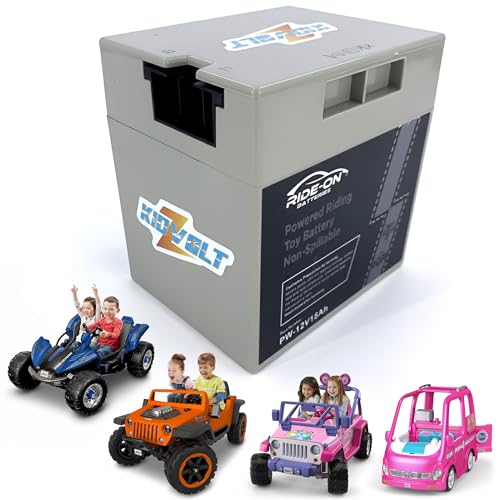
Before ordering, check that your old battery’s part number is in the listing. Impact doesn’t publish this battery’s breaker rating, so for an orange-top car, ask the seller to confirm it has the 40A breaker. It holds more than the 12Ah original, so it charges longer: up to about 26 hours from flat on the 1A Power Wheels charger, and never past Mattel’s 30 hours.
6V Red Battery

This is for 6V cars that came with the red 9.5Ah battery. Some 12V Preschool and Advanced Series cars use two, and Mattel says to replace both together because an old battery can damage a new one. If your car takes two, get the set of two. Charge it on the red-battery charger (00801-1779). The blue-battery charger won’t work.
6V Blue Toddler Battery
The blue 6V 4Ah battery (00801-1457) runs toddler models like the Lil’ Quad, Thomas and Harley-Davidson Lil’ Motorcycle, and has its own 350mA charger. Order it by part number from a Power Wheels service center such as Impact Battery. Some newer toddler cars, such as the Thomas HHP26, use a 6V NiMH pack instead, so check the label.
Power Wheels Chargers (12V and 6V)
Mattel’s manuals call for a genuine Power Wheels charger: 00801-1778 for both 12V batteries, 00801-1779 for the red 6V and 00801-1781 for the blue 6V. A Power Wheels service center can order them. The SafeAMP chargers below list the same output and plug as the originals, one for each battery.
12V gray and orange-top batteries (1A, UL listed):
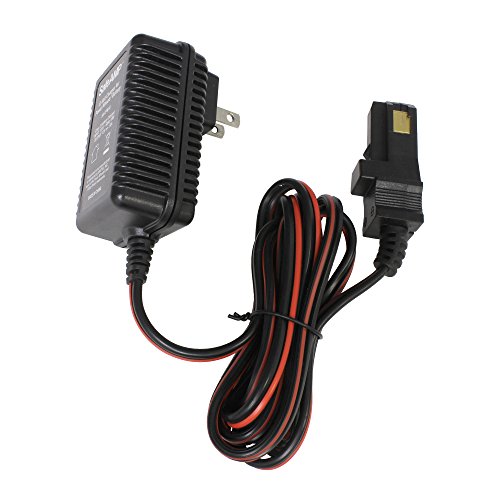
6V red battery (0.9A):

6V blue battery (0.35A, UL listed):

Power Wheels Battery Connector for Standard 12V Batteries
Mattel says to use only Power Wheels batteries (see can you use any 12V battery). An adapter harness lets a standard 12V sealed lead-acid (SLA) battery connect to the Power Wheels plug. The breaker is built into the genuine battery, so with a standard battery the harness needs its own fuse: 30A for gray-battery cars, 40A for orange-top cars, never bigger.
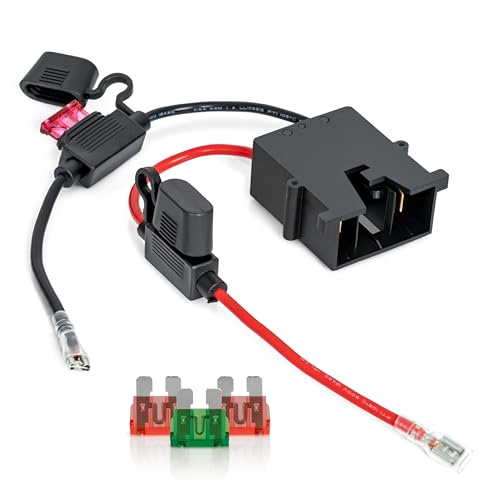
This harness takes a 12V battery with F2 terminals, such as the Mighty Max ML7-12F2. It comes with 30A and 40A fuses: fit the 30A unless your car takes the orange-top battery. A 12V 7Ah battery is much smaller than the Power Wheels battery, so the car’s retainer may not hold it. Strap it down so it can’t slide or fall out if the car tips over, keep the retainer closed, and make sure no bare metal shows at the terminals. Expect shorter rides than with the 12Ah original.
Peg Perego Replacement Batteries and Chargers
Peg Perego batteries have their own plugs, blue on most 12V models and orange or white on some older ones. The cases are color-coded: green for 6V, blue for 12V and yellow for 24V.
Peg Perego says to use only its own batteries and chargers, and genuine parts carry the Peg Perego logo on the case and connectors. More in our Peg Perego ride-ons guide and Peg Perego vs Power Wheels.
Peg Perego 12V 12Ah and 24V Batteries

This official 12V battery (IAKB0501, blue case) fits Peg Perego’s 12V John Deere, Polaris, Case IH and New Holland ride-ons. It’s 12Ah, replacing the older 8Ah, and gives about 1.5 hours per charge.
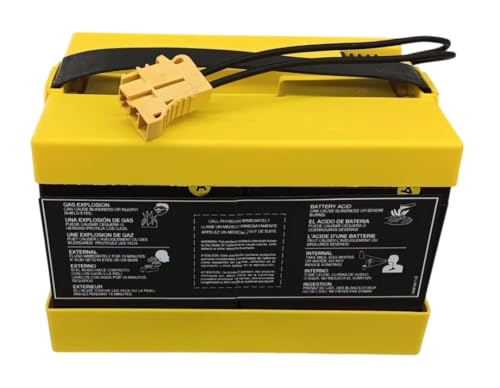
This is Peg Perego’s main 24V pack (IAKB0522): two 12V 12Ah batteries sealed in one case, for the Gaucho Superpower and Polaris Sportsman 800/850. The John Deere Gator XUV 6×4 takes a smaller 24V 8Ah pack (IAKB0529) instead, so match the part number on your old battery before ordering.
For the 6V battery (IAKB0509, green case), order from Peg Perego’s parts store or a Peg Perego dealer.
Peg Perego Chargers
12V charger (IAKB0535, for Peg Perego 12V vehicles only):

24V charger (MECB0111):
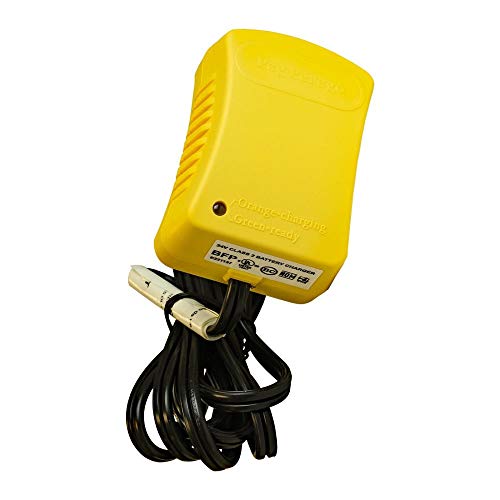
The 24V charger is for the Gaucho Superpower, Polaris Ranger RZR and Polaris Sportsman 800/850. Both put out about 1A. A green light doesn’t prove the battery is full: the charger also shows green when it’s plugged in with no battery attached.
12V and 6V Ride-On Car Batteries (Best Choice, Costzon, Aosom, TOBBI)
Most Amazon ride-ons use standard sealed lead-acid batteries on a wire harness, so you keep the harness and swap the battery. Some makers, Aosom among them, say to use only their own battery, so check whether your car’s maker sells one first.
Best Choice Products’ Jumbo 12V truck and Costzon’s 12V truck use 12V 7Ah, TOBBI’s 12V cars use 12V 4.5Ah and Aosom’s GMC Sierra HD uses 12V 10Ah. Check the old battery for:
- Voltage and Ah. A code like 6-FM-7 means 12V 7Ah, and 3-FM-7 is 6V 7Ah.
- Terminals. F1 is 3/16 in wide, F2 is 1/4 in.
- Size. A 12V 7Ah battery is about 5.94 x 2.56 x 3.70 in. 12Ah batteries are wider and some 10Ah ones are taller.
- Fuse. Keep the car’s fuse at its original rating.
12V 7Ah Battery for Toy Cars
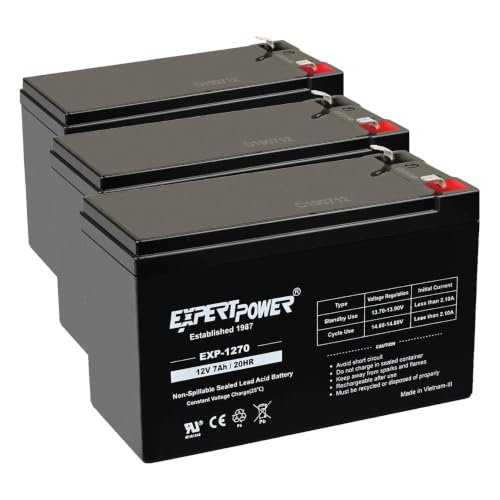
ExpertPower’s 12V 7Ah has F1 terminals and the common 12V 7Ah case (5.94 x 2.56 x 3.70 in). If your harness has the wider F2 connectors, get an F2 battery such as the Mighty Max ML7-12F2. TOBBI’s 12V cars take a smaller 12V 4.5Ah battery, so this one won’t fit them. TOBBI sells its own replacement.
12V Battery With a Red 2-Pin Plug
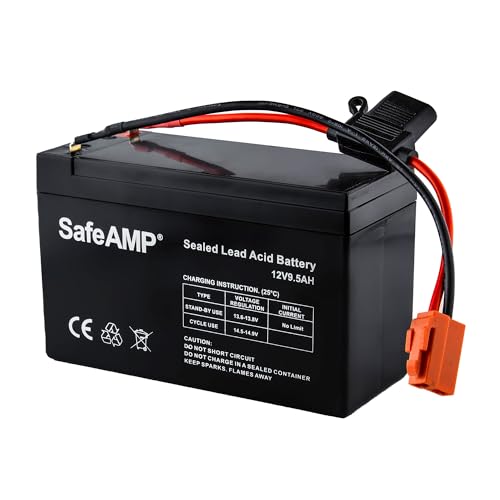
This one is for cars with a red 2-pin plug between the battery and the car, and it comes with that plug on a short harness. Compare it with the product photos first, because look-alike plugs don’t fit.
The harness comes with a 40A fuse. If your old harness had a smaller fuse, swap in one of that smaller rating.
6V 4.5Ah Battery for Small Ride-Ons

Many small 6V ride-ons take a 6V 4.5Ah battery with F1 terminals. This is that battery. 6V 7Ah batteries come in more than one shape, so measure before ordering a bigger one.
24V Ride-On Car Replacement Batteries: One Pack or Two 12V
Most 24V ride-ons run on two 12V batteries wired together (in series), either as two separate batteries or sealed in one case like Peg Perego’s. Many Amazon 24V cars, such as Costzon’s 24V UTV, are listed as 24V 7Ah. A label reading 24V7AH/20HR means 24 volts and 7Ah, measured over 20 hours, and a code like 12-FM-7 is also 24V 7Ah. Look in the battery bay before you order.
- Two separate 12V batteries: replace both at once with two identical batteries (same make, Ah and age). A new battery paired with an old one wears out early. If yours are 12V 7Ah with F1 terminals and the common 7Ah case, two of the ExpertPower 12V 7Ah batteries above will do.
- One 24V pack: match the plug and size. A pack with a different plug, such as an Anderson plug for a car with a red 2-pin socket, won’t connect. Return it rather than splicing wires.
- Charger: a 24V lead-acid charger may say about 28.8V on its label. That’s normal, not too much.
More in 12V vs 24V ride-ons and our 24V ride-on cars guide.
Ride-On Car Chargers: Match the Volts, Plug and Battery Type
A charger must match the battery’s voltage, its type (lead-acid or lithium) and the plug. A 12V lead-acid charger puts out more than 12V, because the battery finishes charging at about 14.4-15V. If you check one with a meter while it’s charging, a reading above 12V is normal.
- No regular car battery charger. Standard ride-on chargers put out 0.35-1A. A ride-on battery shouldn’t get more than 0.3A per Ah of capacity: about 1.3A for a 4.5Ah battery, 2A for 7Ah and 3.5A for 12Ah. A high-amp car charger is too much, and its boost, engine-start and desulfation (repair) modes are worse.
- Use the maker’s charger. Mattel, Peg Perego and Aosom all say to use only their own charger. Don’t swap in a car battery charger, a maintainer, a bench power supply or any other improvised source. If the charger is lost, order the matching one below.
- Other brands’ charger plugs vary. Square, B-type and barrel plugs are all common. Photograph the charging socket and match the voltage, plug and polarity (the + and – marks on the label), ideally with a charger from the car’s maker.
- Lost the charger? Order the matching one: the Power Wheels and Peg Perego chargers are above, and for other brands, match the socket as described above. Don’t improvise with jumper cables, a car battery or another toy’s charger.
- Lithium needs a lithium charger. Never charge a lithium pack on a lead-acid charger, or a lead-acid battery on a lithium charger.
Charger light acting odd? See how to tell if it’s charging.
Is It the Battery? Rule Out the Fuse and Charger First
- Stops under load, then runs after a rest: the thermal fuse or breaker is tripping from weight, hills, soft ground or towing. Release the pedal and wait about 25 seconds (Peg Perego says 10-30 seconds). See Power Wheels thermal fuse problems and how to test a thermal fuse without a multimeter.
- Still dead after a full charge: the charger may be faulty. Some chargers read 0V on a meter unless a battery is connected, so a zero reading doesn’t mean the charger is dead. See ride-on not charging.
- Nothing at all, even with a new battery: make sure a new battery had its full first charge and the plug is pushed all the way in. Then check the connectors, switches and wires with our ride-on car not working guide.
Short rides after a full charge point to a worn-out battery. The test below confirms it.
How to Test a Power Wheels or Ride-On Battery
- Charge the battery fully and unplug the charger.
- Let it rest at least 4 hours (24 is better) so the reading settles.
- Set a multimeter to DC volts. Put the red probe on + and the black probe on -. Don’t let metal touch both terminals at once.
- Compare the reading with the table.
| At rest | 12V battery | 6V battery |
|---|---|---|
| Full | 12.6-12.9V | About 6.3-6.45V |
| Half | About 12.2V | About 6.1V |
| Flat | 11.9V or less | 5.9V or less |
A battery can read full and still be worn out if it only runs the car briefly. If a 24V car has two separate 12V batteries, test each one. If it reads flat after a full charge, see can you fix a dead battery.
Make the New Battery Last
Per charge: a healthy Power Wheels battery should run 1-3 hours, and Mattel treats less as a fault. Other brands often rate their cars for 40 minutes to 2 hours.
Heavier kids, grass and hills cut that further. Try our run time calculator.
In years: Mattel says 1 to 3 years on average, depending on use and care. For longer play, charge a spare and swap it in. Don’t wire a second battery into the car.
Give a new battery its full first charge. Skipping it shortens the battery’s life and voids Mattel’s and Peg Perego’s warranties (see do Power Wheels batteries come charged).
| Brand | First charge | After each ride | Never more than |
|---|---|---|---|
| Power Wheels | 18 hours | At least 14 hours | 30 hours |
| Peg Perego | 18 hours | Right away (18-24 hours from flat) | 24 hours |
| Most other brands | About 12 hours | 8-12 hours | Check the manual (TOBBI 12, Aosom 24) |
- After every ride: charge it, however short the ride. Leaving it on the charger overnight is fine as long as the total stays under the limit in the table. Never leave a battery flat.
- Bigger batteries take longer: a higher-Ah battery on the original charger needs more hours. The 15Ah Impact battery can need up to about 26 hours on the 1A Power Wheels charger after a long ride, still under Mattel’s 30-hour limit. Peg Perego and Aosom allow only 24 hours and say to use their own batteries, so in those cars stay with the maker’s battery. See overcharging and how long to charge a ride-on battery.
- Safety: only adults should handle or charge the battery, and the hold-down always goes back on. Charge upright in a dry, ventilated spot away from anything flammable, never in a closed box. Don’t charge a cracked or leaking battery. Acid on skin or eyes: flush with cool water for 15 minutes and call a doctor.
- Storage: charge fully before storing, then recharge once a month. Unplug it for long storage (see disconnecting the battery and storing Power Wheels batteries). A battery monitor shows the charge at a glance.
- Winter: Mattel says to store the battery between -10°F and 75°F. Keep it charged, because a flat battery can freeze and be damaged at about 5°F. Never charge a lithium battery below freezing.
Before You Upgrade: Bigger, Lithium or Higher-Voltage Batteries
Only a same-voltage lead-acid battery with the right plug is a straight swap. Everything else here changes the car’s electrical system, which Mattel and Peg Perego both warn against. Even factory wiring can overheat: in 1998, Fisher-Price and the CPSC recalled about 10 million Power Wheels over overheating electrical parts, after about 150 fires were reported.
- Higher Ah, same voltage: fine if it fits. You get longer rides and a longer charge. See a bigger battery in a Power Wheels.
- Higher voltage: not as a straight battery swap. It needs rewiring, makes the car faster than it was built for, and overdrives motors, gearboxes, switches and wiring built for the lower voltage. Mattel warns that changing the electrical system can cause a fire. Peg Perego says to use only its own batteries and chargers, and takes no responsibility if the wiring is tampered with. If you still want more speed, do it properly with our speed-mod guide, with a fuse and upgraded gearboxes. See also a 24V battery in a 12V car and a 12V battery in a 6V car.
- Lithium: it needs a battery management system (BMS), a fuse and a lithium charger. The safest route is a pack your car’s maker sells for that model, like TOBBI’s lithium pack for its 12V cars. Lithium packs for 12V cars are labeled 11.1V or 12.8V. Don’t build one from loose cells or use an RC LiPo pack. Never charge it below freezing, unattended, or if it’s swollen or damaged. See lithium vs lead-acid.
- Drill batteries: a “20V MAX” drill battery is really an 18V battery, about 1.5 times what a 12V car is built for. That’s a higher-voltage conversion with the same risks: a faster car and hotter motors, switches and wiring. Never use one on a 6V car. Taking out the Power Wheels battery also removes its thermal fuse, so the adapter needs its own fuse, no bigger than the original (30A for gray-battery cars, 40A for orange-top). An adult should watch every ride, and the tool pack is never charged in the car. Read our drill battery conversion guide and how long drill batteries last first.
- Lawn mower or motorcycle batteries: the same rules apply: same voltage, a fuse no bigger than the car’s original, and a strap or bracket holding the battery down. Use a sealed AGM type only. A flooded battery with filler caps can spill acid if the car tips over, and a lithium motorcycle battery needs a lithium charger. Both are bigger and heavier than ride-on batteries, so check the fit first. See the lawn mower battery and motorcycle battery posts.
Recycling the Old Battery
Most ride-on batteries are lead-acid, and those have to be recycled. Putting them in the trash is illegal in many places, including Florida and Minnesota.
Take the old one to a store that sells car batteries or to a Power Wheels service center. More in how to recycle a Power Wheels battery.
Replacement Battery FAQ
What’s the Best Replacement Battery for a Power Wheels?
The genuine Power Wheels battery that matches the color and part number on your old one (see the finder table above). A battery with the same voltage and plug but more Ah runs longer and takes longer to charge. Thinking about lithium? Read lithium vs lead-acid first.
Is It OK to Use a Higher Ah Battery?
Yes, if the voltage, chemistry and plug match and it fits. It adds run time, not speed, and takes longer to charge. See a bigger battery in a Power Wheels.
Do All Power Wheels Take the Same Battery?
No. The four main types are 12V gray, 12V orange-top, 6V red and 6V blue, and some newer toddler cars use a 6V NiMH pack. Match the color and part number on the old battery.
Will a Standard 12V Battery Work in a Power Wheels?
Only through an adapter harness with its own correctly rated fuse, and Mattel doesn’t approve it. More in can you use any 12V battery in a Power Wheels.
How Long Does It Take to Charge a 12V Peg Perego Battery?
About 18-24 hours from flat on the standard charger, and never more than 24, says Peg Perego’s 12V Gator XUV manual. Charge after every ride, and give a new battery a full 18 hours first: Peg Perego says skipping that permanently damages it. Peg Perego also made a faster 3A quick charger (IKCB0082, earlier IKCB0081), but its own store lists it as unavailable. More in how long to charge a ride-on battery.
For safety gear, see do kids need helmets on Power Wheels.

Kevinsmak
Power Wheels dad. Writing RC Ride On Cars since the start.
Hello! I'm Kevinsmak; I have been a content producer of RC Ride On Cars since the start of this site. I have always enjoyed Power Wheels with my family. My two boys love them, and seeing this helps me make sure this website is very accurate for the safety and enjoyment of your family.
Please be careful and use at your own risk
None of the authors, contributors, administrators, or anyone else connected with RCRideOnCars.com, in any way whatsoever, can be responsible for your use of the information contained in or linked from these web pages.