
The short answer
- Yes, when they’re wired in series. Two 12V batteries joined + to − make a real 24V system. That’s what “(Two 12V) 24V 7Ah” means in my tables, and it’s how Razor builds its 24V quads, karts and dirt bikes.
- The Ah doesn’t double. Two 12V 7Ah batteries in series give 24V 7Ah, not 24V 14Ah.
- Wired in parallel (+ to +, − to −), two 12V batteries stay 12V. You get longer rides at 12V speed, not a 24V car.
- To check a listing, look at the charger first. A 24V ride-on comes with a 24V charger.
If one listing says “24V 7Ah” and another says “2 x 12V 7Ah”, they usually mean the same thing. Razor’s 24V Dirt Quad is a two-battery car: Razor’s parts list calls its battery “2-12V/7Ah” with a fuse. We bought one for our boys, and it’s still going strong after more than four years.
On this page
What Does “(Two 12V) 24V 7Ah” Mean?
It means two 12V 7Ah batteries, with the − terminal of one joined to the + terminal of the other. That’s a series connection: the volts add up (12 + 12 = 24) and the capacity stays at 7Ah. The motors get 24V, the same as from a single 24V pack.

- + terminal
- − terminal
- Wire
- Battery
My comparison tables use three versions. “(Two 12V) 24V 7Ah” is two 12V batteries in series, “(One 24V) 24V 7Ah” is a single 24V pack, and a plain “24V 7Ah” means the maker gives only the total. That last one is the most common: of the 86 24V ride-ons in our spec database, 63 list only the total, 19 say two 12V batteries and 4 say one 24V pack.
Even a “single” 24V battery can be two 12V batteries inside. Peg Perego’s 24V 12Ah pack (IAKB0522) is two 12V 12Ah batteries sealed in one case. The same idea works one size down: some 12V Power Wheels in Mattel’s Preschool and Advanced Series run on a pair of 6V batteries.
Series or Parallel: How Are the Two Batteries Wired?
Series = 24V
+ of one battery to − of the other. Volts add, Ah stays the same: two 12V 7Ah batteries make 24V 7Ah. The motors spin faster. This is how a 24V ride-on with two 12V batteries is wired.
Parallel = still 12V
+ to +, − to −. Volts stay the same, Ah adds: two 12V 7Ah batteries make 12V 14Ah. The car goes no faster than on one battery, but it runs about twice as long.
Both setups store the same energy. Watt-hours are volts times amp-hours, so two 12V 7Ah batteries hold 168 Wh either way (24 × 7, or 12 × 14).
Series spends it at 24V, so the car is faster and uses it faster. That’s why a 24V car with two 12V batteries doesn’t run twice as long as a 12V car with one. Costzon rates its 24V 7Ah UTV for about 60 minutes a charge, and Best Choice Products gives its 12V 7Ah truck 1–2 hours.
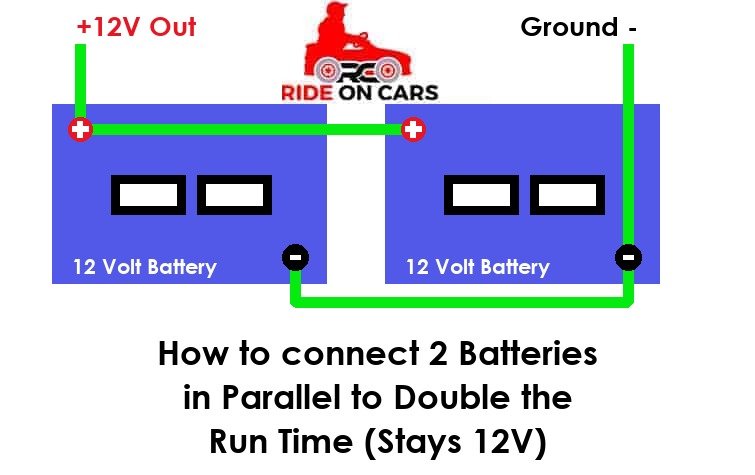
- + terminal
- − terminal
- Wire
- Battery
Parallel is mostly a home-built run-time setup, and I don’t recommend wiring a second battery into a ride-on. For longer play, charge a spare and swap it in.
How Can I Tell From the Listing?
- Read the battery line in the specs and photos. “24V 7Ah”, “2 x 12V 7Ah” and “24V (2*12V 7Ah series connection)”, the wording in Sopbost’s manual for its 24V UTV, all describe a real 24V system. On a battery label, a code like 12-FM-7 means twelve 2V cells: 24V 7Ah.
- Check the charger. This is the best tell. A 24V car comes with a 24V charger, like the “DC 24V 1A” charger Best Choice Products lists for its 24V truck. A 24V lead-acid charger can say about 28.8V on its label, which is normal. Two 12V batteries with a 12V charger means a 12V car with longer run time.
- Check the motors. Many listings print the motor voltage, like Blitzshark’s “4*120W/ 24V”. Wattage is only a clue: in our database, 26 of the 28 12V cars that list a wattage use 25–45W motors and 58 of 65 24V cars use 65W or more, but Sopbost’s 24V UTV has four 35W motors.
- Settle it with the manual. Many listings link one under “Product guides and documents”, and makers like Razor post theirs online. Top speed helps less: most 12V cars in our database top out around 3 mph and most 24V cars around 5.
Real Battery Lines, Decoded
| What the specs say | What’s inside | Example |
|---|---|---|
| (Two 12V) 24V 7Ah | Two 12V 7Ah batteries in series: 24V, 7Ah | Razor Dirt Quad: one 350W motor, 8 mph, ages 8 and upCheck at Amazon: Razor Dirt Quad |
| 24V 7Ah | Two 12V 7Ah batteries in series: the listing gives only the total, and Sopbost’s manual shows the pair | Sopbost 24V Ride-On UTV: four 35W motors, 5 mph, up to 110 lbCheck at Amazon: Sopbost 24V Ride-On UTV |
| (One 24V) 24V 7Ah | One 24V pack: the listing says “a single 24V battery” | OTTARO 24V 2-Seater Ride-On Truck: four 100W motors, 3.5 mphCheck at Amazon: OTTARO 24V 2-Seater Ride-On Truck |
| 24V 12Ah (Peg Perego) | Two 12V 12Ah batteries sealed in one case | Peg Perego Polaris Sportsman 800/850 and Gaucho Superpower |
| (Two 6V) 12V | Two 6V batteries in series: 12V | Some Power Wheels Preschool and Advanced Series cars |
| 2 x 12V, 12V charger | Two 12V batteries in parallel: still a 12V system | Mostly home-built run-time setups |
Are Two 12V Batteries Better or Worse Than One 24V Pack?
On the driveway there’s no difference: 24V is 24V. It matters when the batteries wear out.
- Two 12V batteries are usually a standard size. A 12V 7Ah battery is about 5.94 x 2.56 x 3.70 in, a case many battery makers sell. Replace both at once with an identical pair: Mattel warns that a new battery can be damaged if it’s used with an old one, and battery maker Power-Sonic says batteries in series should share the same make, capacity and age.
- One 24V pack has to match the car’s plug and battery bay, so check the part number or measure before you order.
My guide to replacement 12V and 24V ride-on batteries covers both.
Can I Make My 12V Ride-On 24V With a Second Battery?
Not by just adding a battery. A second 12V battery in series doubles the voltage on motors, gearboxes, switches and wiring built for 12V.
Mattel says never to modify the electrical system because it could cause a fire, and Peg Perego warns that more voltage can damage the motor and gears. If you still do it, it’s adult work: 24V-rated parts, a fuse on the + wire at the battery, a matched pair of batteries and a 24V charger.
Start with the safety section of my mod guide, then my post on putting a 24V battery in a 12V car. For most families, a ride-on built for 24V is the simpler answer.
Safety first: only adults should handle or charge ride-on batteries. Charge with the charger that came with the car, for the hours in its manual: a 24V car on its 24V charger, a 12V car on its 12V charger. Mattel warns that the wrong type of battery or charger could cause a fire or explosion. Charge upright in a dry, ventilated spot away from anything flammable, and never charge a cracked or leaking battery. More in how to charge a Power Wheels.
Questions Parents Ask
Is 2x12V the same as 24V?
Yes, in series, and that’s the only way two 12V batteries make 24V. So a ride-on sold as 24V with two 12V batteries is a real 24V car. In parallel they stay 12V.
Do two 12V batteries last twice as long?
Only in parallel, at 12V speed. In series the faster car uses its energy faster, and most 24V cars in our spec database list about 1–2 hours per charge, much like 12V cars.
Can I charge a 24V ride-on with a 12V charger?
No. Use the 24V charger that came with the car. Mattel, Peg Perego and Aosom all say to use only their own charger, and the wrong charger is a fire risk.
Is a 24V ride-on faster than a 12V one?
Usually, by less than you’d think. In our spec database, 24V cars, trucks and UTVs have a median top speed of 5 mph and 12V ones 3.1 mph, and a genuine 12V Power Wheels reaches 5 mph in high. Here’s how fast 6V and 12V Power Wheels go, and my take on 12V vs 24V ride-ons.
Two 12V batteries plus a 24V charger means a real 24V ride-on. Shopping now? My 24V ride-on car picks list every car’s battery setup this way.
