

The short answer
The quickest way to make a Power Wheels faster is free: remove the high-speed lock-out screw, which takes most 12V Power Wheels from 2.5 to 5 mph. After that, more voltage means more speed. Taking a 12V car to 18V, with a 6V battery wired in series or a drill battery adapter, makes it roughly 50% faster. Put a fuse on the + wire every time, and add a soft-start speed controller and stronger gearboxes to keep it running.
Power Wheels are so much fun for kids. But once they get used to the speed, the same old slow ride gets boring. Here’s how to speed one up, step by step, with wiring diagrams for the battery and fuse hookups.
On this page
- How Can I Make My Power Wheels Faster?
- How to Change Speed on Power Wheels: Lock-Out Screws and Speed Switches
- Safety First: Before You Make It Faster
- How Can I Make My 12V Power Wheels Faster? (18V Battery Upgrade)
- Electronic Speed Controller: Soft Start and a Top Speed You Set
- Custom Fabrication: Motors, Gearboxes, Traction and Brakes
- Trick It Out
- Best Power Wheels to Modify
- Power Wheels Upgrade Kit: Parts for Each Mod
- How Fast Do 6V, 12V, 24V and 36V Ride-Ons Go?
- Can You Put a 24V Battery in a 12V Power Wheels?
- How Can I Make My 24V Power Wheels Go Faster?
- How Can I Make My 6V Power Wheels Faster?
- How Do I Convert 24V to 12V?
- Rather Buy a Faster Ride-On?
- Conclusion
How Can I Make My Power Wheels Faster?
There are four stages to modifying a Power Wheels: the battery, an electronic speed controller, custom fabrication, and then trick it out. Check the free settings first:
- Unlock high speed FreeMost 12V Power Wheels go from 2.5 to 5 mph.
- Battery modification12V to 18V is roughly 50% faster, about 7-7.5 mph instead of 5.
- Electronic speed controllerSmooth starts that save the gears, and a top speed you set.
- Custom fabricationMotors and gearboxes built for the new voltage, plus traction, lift and brakes.
- Trick it outPaint, lights and a battery meter.
How to Change Speed on Power Wheels: Lock-Out Screws and Speed Switches
Most 12V Power Wheels have two speeds, and many ship with high speed locked out. Mattel does this so the ride-on can be set to slow until the child gets used to it, then changed to fast.
A good example of this is the Dune Racer. To unlock high speed:
- Put the shifter in reverse.
- Remove the lock-out screw from the shifter base.
- Store the screw in the hole on the shifter so it doesn’t get lost. Putting it back in the base locks out high speed again.
Now you have double the speed: 2.5 mph in low and 5 mph in high. Reverse stays at low speed. There is a visual guide of the lock-out screw on page 21 of the Dune Racer manual on Mattel’s site.
Mattel’s rule: leave high speed locked out until your child knows how to steer, start and stop, and knows the safe driving rules. This is a great feature when your child is new to the vehicle, because it helps them get used to it before you turn the speed up.
How the two speeds work
In low, the shifter wires the two motors in series, so each one gets about half the battery (about 6V on a 12V car). In high, they’re wired in parallel and each gets the full 12V. That’s why high is about twice as fast, and why any extra battery voltage goes straight to both motors.
Some cars use a high/low switch on the dash instead of a shifter, and many ride-ons from other brands have a parent remote with its own speed setting that may start in low. If yours works a different way, check the manual or the questions on its Amazon page. Another great place for help is the Reddit community for Power Wheels Mods.
Still slow in high? A worn-out battery is the usual cause. Charge it fully, then test it: our replacement battery guide shows how. If your car takes the all-gray battery, the replacement is the genuine 12V Power Wheels battery. Orange-top cars need their own, which the guide also covers.
Safety First: Before You Make It Faster
More speed changes who can safely drive the car (see are ride-on cars safe). Before any battery or motor mod:
- An adult does the work and watches every ride. Mattel requires direct adult supervision, and only adults should handle, wire or charge the batteries.
- A helmet on every ride. For comparison, Razor’s own dirt bike manual rates 10 mph for ages 8 and up and 14 mph for 13 and up, with a helmet required. Use a CPSC-certified bike helmet, plus pads if your child will wear them. See do kids need helmets on Power Wheels.
- Respect the age and weight limits. The 12V two-seat Power Wheels are rated for ages 3 and up and 130 lb total. Extra weight means more current and heat, and the car trips its fuse. See the ride-on weight limits.
- Safe places only. No streets, driveways, pools, steps or steep hills, and never at night.
- Stop before switching between forward and reverse. It saves the gears. A faster car also needs more room to stop: plastic wheels don’t grip like rubber, and the stock brake is just the motors stopping when the pedal comes up.
- Buckle up. Make sure the seat belts are sufficient for your child, or upgrade the seat belts.
- Know what you’re giving up. Mods void the Power Wheels warranty, and Mattel warns that changing the electrical system can cause a fire. In 1998, Fisher-Price and the CPSC recalled about 10 million Power Wheels over overheating electrical parts. Fuse every battery mod, and feel the wires and motors after a ride: if they’re hot, stop and find out why.
How Can I Make My 12V Power Wheels Faster? (18V Battery Upgrade)
After the lock-out screw, the easiest and simplest way of modifying a Power Wheels is the battery. Motor speed goes up roughly in step with voltage, so a 12V car on 18V runs about 50% faster: about 7-7.5 mph in high instead of 5, a little more on a fresh battery. You can do this at home on your own, with one of two setups: a 6V battery added to a 12V battery, or an 18V drill battery on an adapter.
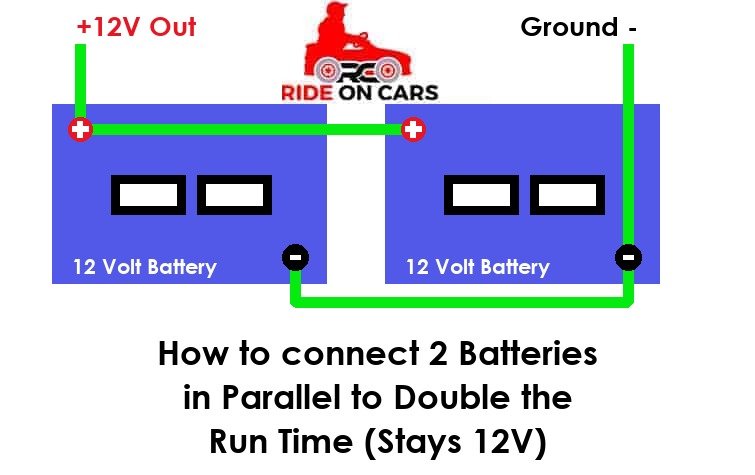
Series vs parallel: speed or run time, not both.
Series = speed
Wiring batteries in series (+ of one to – of the next) adds their volts, so the car goes faster, but the run time stays about the same or gets shorter, because the car draws more power.
Parallel = run time
Wiring them in parallel (+ to +, – to -) keeps the volts and adds the Ah, so the car runs longer at the same speed.
More in how long a Power Wheels battery runs per charge and putting a bigger battery in a Power Wheels.
- + terminal
- − terminal
- Wire
- Battery
What 18V costs you: the stock motors, plastic gears, switches and wiring are built for 12V, so at 18V they run hotter and wear out faster (see gearboxes). Never do it on a 6V car.
Option 1: Add a 6V Battery in Series (12V + 6V = 18V)
- + terminal
- − terminal
- Wire
- Battery
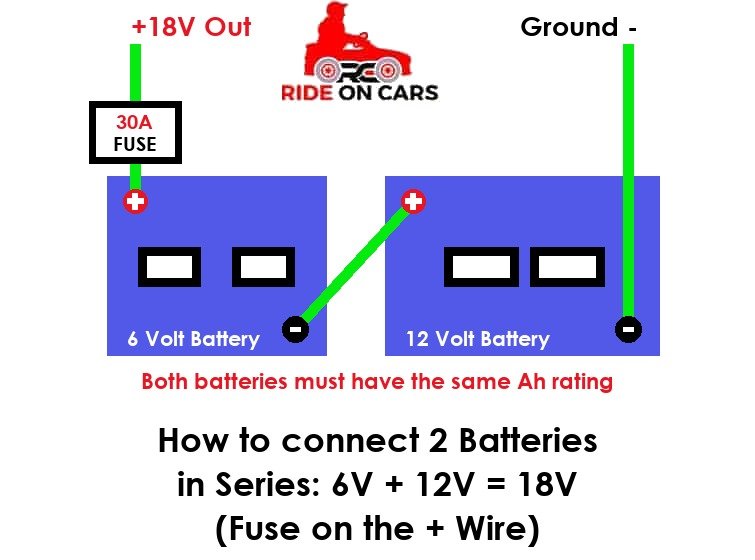
This is the classic 18V mod: a 12V and a 6V sealed lead-acid battery wired in series, like the diagram above.
- Buy a matched pair. Both batteries need the same Ah rating, the same type (AGM/SLA) and the same age, ideally the same brand bought together. If they don’t match, the smaller battery gets drained too far and fails early. Don’t pair a new 6V with the car’s old Power Wheels battery.
- Link them. Connect the 6V battery’s – terminal to the 12V battery’s + terminal with a short 12 AWG jumper.
- Fuse the + wire. The 6V battery’s free + terminal is now the pack’s +18V. Put a 30A fuse on that wire, right at the battery (see where the fuse goes).
- Connect it to the car. The fused +18V wire and the 12V battery’s free – terminal go to the car’s battery connector. Our drill conversion guide shows how to reuse the plug from the old battery.
- Make it fit and strap it down. You may need to trim the battery compartment or build a small tray. Strap both batteries down so they can’t slide, and cover every terminal so no bare metal shows.
- Charge them separately. The car’s 12V charger can’t charge an 18V pack. Unhook the link and charge each battery on its own charger (a 12V charger on the 12V, a 6V charger on the 6V), or use a charger made for an 18V lead-acid pack. See how to charge Power Wheels.
Stick-on heat sinks for the motors are optional but cheap insurance at 18V. They go on the motors, not the batteries.
Option 2: Drill Battery Conversion (18V or 20V MAX)
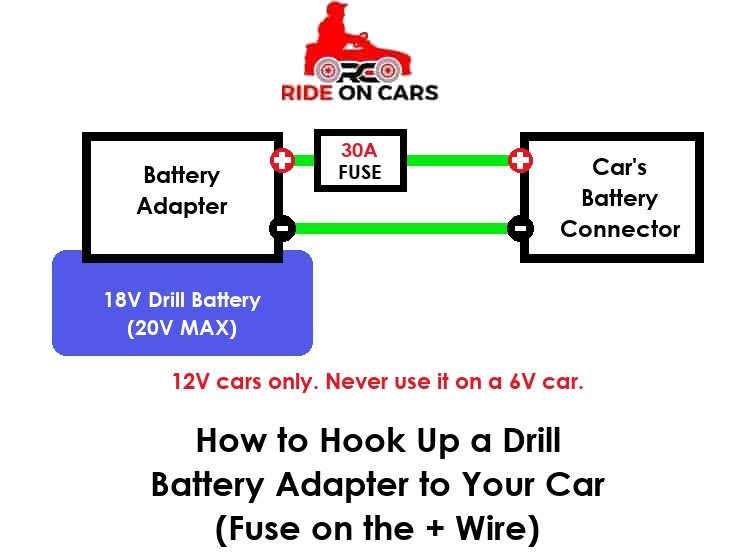
Do you have extra power tool batteries lying around? If so, you can do the drill battery conversion. An adapter clips onto the tool battery and connects to the car’s battery plug.
- + terminal
- − terminal
- Wire
- Battery
A “20V MAX” battery is an 18V battery. DeWalt says 20V is the voltage with no load and 18V is the nominal voltage, so 18V and 20V MAX packs give the same result: roughly 50% more speed on a 12V car. Never use one on a 6V car. That’s three times the voltage its motors were built for.
- Fuse the red wire at the adapter. Taking out the Power Wheels battery removes its built-in thermal fuse. Some adapters come with a fuse holder. If yours doesn’t, add one.
- Adapters don’t protect the battery. They pass the pack’s voltage straight through, and many tool packs rely on the tool to stop them draining too far. An over-drained lithium pack may not charge again and can become a fire risk, so stop when the car slows down, or use a controller with a low-voltage cut-off.
- Expect shorter rides. Even a 5Ah drill pack holds less energy than the stock 12V Power Wheels battery. See how long drill batteries last in Power Wheels. Two identical, equally charged packs on two adapters can go in parallel for longer rides, but never in series: two 18V packs in series make 36V.
- Charge the pack on its own tool charger, off the car. Never on the Power Wheels charger.
For other brands, these adapters come with a switch and a 30A fuse: Milwaukee M18, Makita 18V LXT (2-pack) and Ryobi 18V ONE+. Want it all in one box? This DeWalt adapter and controller kit adds low-voltage protection, a soft-start speed controller, a variable-speed pedal, a brake pedal and a fuse.
Where the Fuse Goes (Every Battery Mod Needs One)
- + terminal
- − terminal
- Wire
- Battery
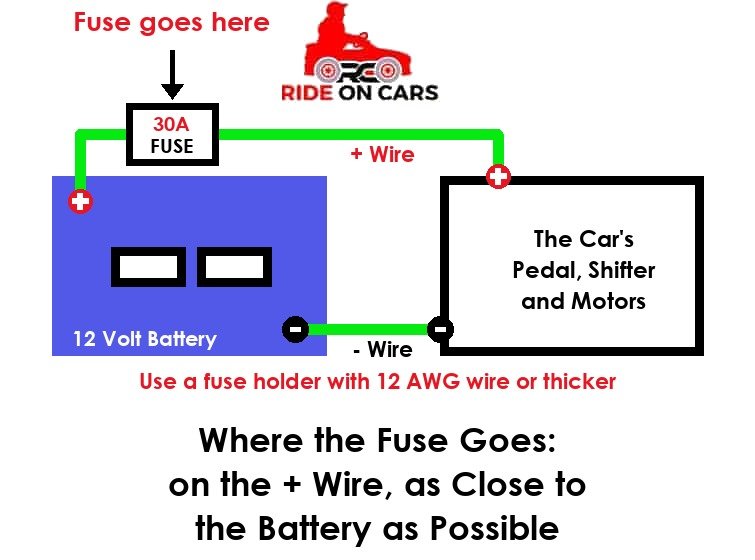
The stock Power Wheels battery has a self-resetting thermal fuse built in. Swap in any other battery, or rewire it, and that protection is gone, so add an inline fuse:
- On the + (red) wire, as close to the battery as possible. Everything between the battery and the fuse is unprotected, so keep that bit short.
- No bigger than the original. That’s 30A for cars that came with the all-gray battery and 40A for orange-top cars. Use 12 AWG wire or heavier with a 30A fuse, and 10 AWG with a 40A fuse.
- Blown fuse? Find out why. If a fuse keeps blowing, look for a stalled motor, a binding gearbox or a short before you think about a bigger one, and never bypass it. See Power Wheels thermal fuse issues and how many amps a Power Wheels draws.
Keep spares on hand: a blade fuse assortment covers both sizes. For new wire runs, 12 AWG red/black silicone wire matches the fuse holder. More on wiring in how to rewire a Power Wheels.
Electronic Speed Controller: Soft Start and a Top Speed You Set
Coming to the next stage, the electronic speed controller. A stock Power Wheels has no real speed control: the pedal is an on/off switch, so the car jumps to full power every time. A speed controller (an ESC, or PWM controller) sits between the battery and the motors and meters the power, so the car gets:
- A soft start. It ramps the power up over a few seconds instead of slamming the gears. That protects the plastic first gear and the switches, and it’s gentler on your child. At 18V, it’s one of the best ways to make the gearboxes last.
- A top speed you set. Many controllers have a knob that you turn to adjust the amount of power the Power Wheels uses. Turn it down for a new driver and up as they get better.
- Battery protection. Some have a low-voltage cut-off, which matters with lithium drill packs.
A controller won’t raise the top speed. It makes the speed you have smoother and easier to control. Pick one made for brushed DC motors (Power Wheels motors are brushed), rated for your battery voltage and at least 30A. Wire it after the fuse, between the battery and the car’s forward/reverse switch, as its instructions show, and mount it with screws or zip ties somewhere dry with airflow, away from the battery terminals. Don’t just tape it in.
Want a real variable-speed gas pedal and a brake pedal too? Get the MgcSTEM kit with pedals. Prefer the simple knob type? The TKXEC 60A controller has a speed knob and a display.
Skip scooter controllers, like Razor’s: they need a scooter throttle and voltage, and some, like the Razor E100’s, only engage once the scooter is already moving. A parent remote is another way to control the speed. More in our Power Wheels speed controller guide.
Custom Fabrication: Motors, Gearboxes, Traction and Brakes
Moving on to custom fabrication: cutting, drilling and bolting in new parts. For speed, that means motors and gearboxes that can take the extra voltage.
12V Power Wheels use 550-size motors built for 12V. Some people run them at 18V, but they wear out faster, and the plastic first gear in each gearbox is the weakest link. We recommend upgrading the gearboxes along with the battery, or a few months later the plastic ones will grind down. This will be apparent by a grinding noise coming from the tire area of the Power Wheels.
For 24V builds, the JRRXM 24V steel-gear gearbox pair is rated 18-24V. Staying at 12V? A higher-RPM 12V motor and gearbox, like the SHENGLE RS550 12V gearbox, is sold as a speed upgrade by itself. It’s one unit, so buy two to keep both rear wheels matched. Gearboxes differ in axle hole size and mounts, so compare yours with the gearbox identification guide first. More in our metal gearbox upgrade guide.
The Power Wheels won’t move very fast if it doesn’t have good traction on the tires. There are ways to add more traction to tires so they grip on grass and hills. One catch: a spinning plastic tire is the car’s only “clutch.” Grippy tires plus extra voltage plus stock plastic gears is the combination that strips gears, so pair traction with a soft-start controller and stronger gearboxes.
Lifted Power Wheels also look very sweet, and they will give more room between the plastic wheel well and the tires. Bigger tires make the car a little faster, but they work the motors harder.
Once you get the Power Wheels really moving, you can install a brake pedal so it stops quicker and more smoothly. You can even take it a step further and install a Power Wheels shifter! Gas engines and go-kart motors are another story: those are adult builds, not upgrades for a kid’s car.
Looking for more like this?
Trick It Out
Here’s the last stage of modification: make the car look as good as it goes. You can make it fancy, gorgeous, cool or funky by adding accessories, or even paint the ride-on.
You can also add LED headlights and taillights, a reverse buzzer or a sound module. After an 18V or 24V upgrade, run 12V lights and sound through a step-down converter (see converting 24V to 12V) so they don’t burn out.
Keeping the dashboard looking fresh and bright really makes the car feel real. Why not add a battery meter to the Power Wheels so your kids can see how much battery they have left to drive around? A DROK 10-100V battery monitor reads 12V, 18V and 24V packs, so it still works after the upgrade. Set it for your battery type, since it’s set up for 12V lead-acid out of the box.
If you run into any issues, please make sure to check our Power Wheels solutions article.
Best Power Wheels to Modify
The best Power Wheels to modify are just that, Power Wheels. A lot of the vehicles we recommend here on the site will have no issues with modifications. Standard 12V Power Wheels are the easiest, because so many upgrade parts are made for their gearboxes. SmartDrive models, such as the Mustang and the Barbie Dream Camper, don’t work with some add-on modules, so check a part’s fit list first.
Be careful with really cheap eBay knock-offs like the HP-00Z, you will notice the price is almost cut in half. When doing upgrades on these vehicles, the control boards can’t handle it, so the ride-on will turn off after 2-3 minutes until it cools down.
Power Wheels Upgrade Kit: Parts for Each Mod
No single kit fits every car, so here’s what each upgrade needs. Check your car’s voltage, plug and gearbox size before you order. More parts are in our Power Wheels replacement and upgrade parts list.
| Upgrade | What you need | Example |
|---|---|---|
| Tired battery | Same-voltage replacement | Power Wheels 12V battery (gray) |
| 18V with a 6V battery | 12V and 6V batteries with the same Ah | Mighty Max 6V 12Ah + Mighty Max 12V 12Ah |
| 18V with a drill battery | Adapter for your tool brand | DeWalt, Milwaukee, Makita, Ryobi |
| Every battery mod | 30A fuse holder with 12 AWG wire | DaierTek fuse holder |
| Smooth starts and a speed limit | Brushed-motor soft-start controller | MgcSTEM controller |
| Gearboxes for 18V | 18-21V gearbox pair | RS555 18-21V pair |
| 24V conversion | Harness, switches, 24V gearboxes, 24V battery and charger | JRRXM 24V kit |
| 12V lights after 18-24V | Step-down converter | Kohree 24V-to-12V |
| Battery meter | 10-100V monitor | DROK monitor |
| Helmet | CPSC-certified bike helmet | Bell Rally (ages 5-8) |
How Fast Do 6V, 12V, 24V and 36V Ride-Ons Go?
The speed of a ride-on depends on its motors, gearing and wheel size, not only the volts. Here’s what the ride-ons in our database actually do:
| Voltage | Cars, trucks and UTVs | Karts, bikes and quads |
|---|---|---|
| 6V | About 1-3 mph, usually one speed | About 1-3 mph |
| 12V | About 2-5 mph (most about 3; Power Wheels 2.5 low, 5 high) | Up to 8 mph |
| 24V | About 3.5-7.5 mph (most about 5) | 7.5-15 mph |
| 36V | None we track | 9.5-17 mph, mostly for ages 14-16 and up |
| 48V | Not Power Wheels | Teen go-karts, around 20 mph, for ages 13 and up |
The 2014 Power Wheels Corvette Stingray was billed as the fastest Power Wheels of its day, at 3 mph in low and 6 mph in high. It’s discontinued now. Today’s fastest 24V cars and UTVs reach about 7.5 mph, and Razor’s fastest karts and dirt bikes go 12-17 mph, for kids 8 to 16 and up. More details on 24V speeds can be found here.
Once you have a fast ride-on car, did you know you can race Power Wheels?
Questions
Can You Put a 24V Battery in a 12V Power Wheels?
It will run, but not for long on stock parts. Doubling the voltage roughly doubles the motor speed, to about 10 mph instead of 5, and roughly quadruples the power and heat in motors and gearboxes made for 12V. One of the biggest upgrade-parts makers says that at 24V even a performance 550 motor won’t last a day. Here are the main differences between 12V and 24V, and our full answer on putting a 24V battery in a 12V car.
We do recommend doing a motor upgrade on the vehicle, because the power won’t match up correctly. You will most likely still be able to run it without one, but the motor will overheat and wear out at an accelerated rate. A full 24V conversion needs:
- 24V-rated motors and gearboxes with steel gears.
- A 24V battery (two identical 12V batteries in series) and a 24V charger. The car’s 12V charger can’t charge it.
- A fuse on the + wire at the battery, and 12 AWG or heavier wire.
- Wiring and switches that can take the current. The stock pedal and shifter switches handle only about 20A, so bigger builds add relays or a new harness, plus a soft-start controller rated for 24V.
Conversion kits like the JRRXM 24V conversion kit bundle a new wiring harness, pedal and speed switches, a 25A fuse and two 24V gearboxes. You add the 24V battery and charger. Check the gearbox fit (12 mm axle hole) before you order.
You’ll also see 18V conversion kits advertised with longer run time. The extra run time comes from their 12Ah batteries, which are bigger than the older 9.5Ah Power Wheels battery, not from the higher voltage. For most families, 18V is the sweet spot. 24V on a 12V car is a full rebuild, and only for older kids.
How Can I Make My 24V Power Wheels Go Faster?
Most 24V ride-ons top out around 5 mph, and the fastest 24V cars and UTVs we track, like the Peg Perego Polaris RZR PRO, reach about 7.5 mph. Many 24V cars aren’t much faster than 12V ones because their 550 motors are wound for 24V. To get more:
- Check the speed settings. Look for a high/low switch or lock-out, and check the parent remote, since many start in low.
- Charge or replace tired batteries. If the car runs on two 12V batteries, replace both together with an identical pair (see the battery guide).
- Fit faster 24V motors and gearboxes. 775-size motors have much more torque than 550s. The JRRXM RS775 24V gearbox is rated 18-24V, and its seller says to pair it with a controller of 40A or more and a fuse of at least 25A. 775 motors are bigger, so measure your mounts first.
- Add a soft-start controller rated for 24V and for your motors. The MgcSTEM above works up to 70V, but it cuts the power back above 30A continuous, less than the 40A that 775 seller asks for. Add traction if the tires spin.
Don’t go past 24V on a kids’ ride-on. Standard blade fuses are only rated to 32V, and 36V machines like Razor’s dirt bikes and karts are purpose-built, with metal drivetrains and real brakes, for ages 14 to 16 and up.
How Can I Make My 6V Power Wheels Faster?
Most 6V Power Wheels are toddler rides with one forward speed of about 2 mph, and that’s on purpose: Mattel’s 6V Lil’ Quad, for example, is made for ages 1 to 3.
First things first, charge the battery fully, and if it’s a couple of years old, test or replace it. If your car does have a high/low switch, make sure it’s set to high.
Don’t put a 12V battery or a drill battery on a 6V car. 12V doubles the voltage on small motors and gearboxes built for 6V, an 18V drill pack triples it, and they fail fast. If your child has outgrown 2-3 mph, it’s time for a 12V ride-on. See can you use a 12V battery on a 6V Power Wheels and our best Power Wheels for ages 3 to 7.
How Do I Convert 24V to 12V?
Usually the real question is how to slow a 24V car down for a younger driver. Don’t do it with resistors: a resistor turns the extra power into heat (at 20A, even a 0.3-ohm resistor makes 120 watts of it), which is a burn and fire risk. Instead:
- Use the car’s low-speed switch or lock-out.
- Use the parent remote’s speed setting, if the car has one.
- Fit a PWM speed controller with a max-speed setting.
Need 12V for lights or a sound module on a 24V or 18V car? That’s what a step-down converter is for, like the Kohree 24V-to-12V converter. It takes 18-35V in, so it’s the best fit on 24V. On an 18V pack it can cut out as the battery runs down. It’s for accessories only, not the drive motors.
Rather Buy a Faster Ride-On?
For older kids, some ride-ons are built fast from the factory, with the motors, brakes and frames to match. We have a list of Power Wheels that are made for older children, these are the fast ones! Here are the fastest Power Wheels we can find.
Razor Dirt Quad Electric Off-Road Vehicle
- Ages
- 8+
- Max weight
- 120 LBS
- Battery
- (Two 12V) 24V 7aH
- Top speed
- 8 MPH
- Seats
- 1
- Parent remote
- No
Specs checked Sep 2026
VerdictIf your child is 8 or older and wants a real quad-style ride with a twist-grip throttle, this is a great choice for driveways, paths and other flat, smooth ground. It has an attractive design and offers several features that will satisfy your child’s outdoor play requirements.

The Razor Dirt Quad goes up to 8 mph (it has a low speed too) for riders 8 and up and up to 120 lb. Razor says to ride it on flat, smooth ground only. Read our Razor Dirt Quad review.
Key Features
- This vehicle boasts a max speed of 8 mph and can support a rider weight of up to 120 lb.
- It runs up to 40 minutes on high speed (up to 80 minutes on low) and requires some assembly.
- Features shatter-resistant plastic fairings and a powder-coated tubular steel frame.
- Equipped with 12″ pneumatic knobby tires and adjustable riser handlebars for comfortable riding.
- Razor says it is not an ATV: ride it on flat, smooth surfaces only, not on rough terrain such as rocky trails or sand, or on wet or icy ground.
Pros
- Realistic quad bike design
- Twist-grip throttle with a high/low speed switch
- Hand-operated rear disc brake
- 12-inch air-filled tires smooth out bumps
Cons
- Up to 40 minutes of riding on high speed (80 on low)
Razor Ground Force One Go-Kart
- Ages
- 8+
- Max weight
- 140 LBS
- Battery
- (Two 12V) 24V 7aH
- Top speed
- 12 MPH
- Seats
- 1
- Parent remote
- No
Specs checked Sep 2026

Razor’s Ground Force One go-kart reaches 12 mph, for ages 8 and up and riders up to 140 lb, and it has a hand brake. Helmet on, every ride.
For more, see the best 24V ride-on cars, the best 36V ride-on toys and Power Wheels for big kids.
Conclusion
Please be safe in doing any of these upgrades to your Power Wheels. You want to make sure that the ride-on car doesn’t go too fast for the child, but a lot of times, they are ready for the next level and this guide will help you accomplish this. Start with the free lock-out screw, go to 18V with a fuse on the + wire, and add a soft-start controller and stronger gearboxes before the old ones grind out.
Now you know how to modify Power Wheels for your kids. Interested in learning how to modify Power Wheels for adults?

Please be careful and use at your own risk
None of the authors, contributors, administrators, or anyone else connected with RCRideOnCars.com, in any way whatsoever, can be responsible for your use of the information contained in or linked from these web pages.
