The short answer
- Stop it first. Lift your kid out, then unplug the battery. Don’t let anyone drive it again until you’ve found the cause.
- A ride-on should stop the moment the foot comes off the pedal. The pedal is an on/off switch, and letting go of it brakes the motors.
- If it keeps going, the usual causes are a pedal stuck down, a pedal switch whose contacts have stuck closed, a parent remote that’s still driving it, or a wiring problem.
On this page
First, stop it safely
A car that keeps moving with a kid on board needs an adult hand, not a fix. Do these in order, as fast as you safely can.
- Use the parent remote if you have it. Press its stop or park button, or steer the car away from anything it could hit.
- Get your kid out. Walk beside the car and lift them out once it’s slow enough, or stop it with your hand on the frame. A kids’ ride-on is light enough for an adult to hold.
- Turn the power switch off if the car has one.
- Unplug the battery. Pull the connector apart at the battery. That cuts all power, whatever is causing it.
Safety first: a ride-on that kept going after the pedal came up stays parked, battery unplugged, until you’ve found and fixed the cause. An adult does every check below, and the battery stays unplugged while you touch the pedal, switch or wiring.
Why a ride-on should stop when the foot comes up
On a stock Power Wheels, the foot pedal is a plain on/off switch. When your kid lifts their foot, the switch connects the motor’s wires together, and the spinning motor turns into a brake.
Mattel calls it an electronic braking system that “automatically stops the vehicle when your child’s foot lifts from the pedal.” Other brands stop the same way, some more gently because their control board eases the stop, so a car that keeps driving under power is a fault.
One case isn’t a fault. Mattel warns that near a steep slope a car can “gain unsafe speed, even if the pedal is released,” because gravity beats the motor brake, so keep kids off steep hills and driveways.
Five causes, in the order to check them
Start with the quick look and work toward the wiring. Most of the time it’s one of the first two.
| What you see | Likely cause | What to do |
|---|---|---|
| The pedal stays down or comes up slowly | Pedal stuck: mud, a toy, the floor mat, a broken spring | Clear it and check it springs back |
| The pedal comes up, the car keeps going | Pedal switch stuck closed | Check or replace the switch |
| It moves with nobody pressing the pedal | Parent remote in control | Switch to manual, pull the remote batteries |
| It started after a mod or new wiring | Wiring that skips the pedal, or a failed speed controller | Undo the mod, recheck the wiring |
| It smells hot, or a wire looks melted | Shorted or overheated wiring | Stop using it and call the maker |
1. A pedal that’s stuck down
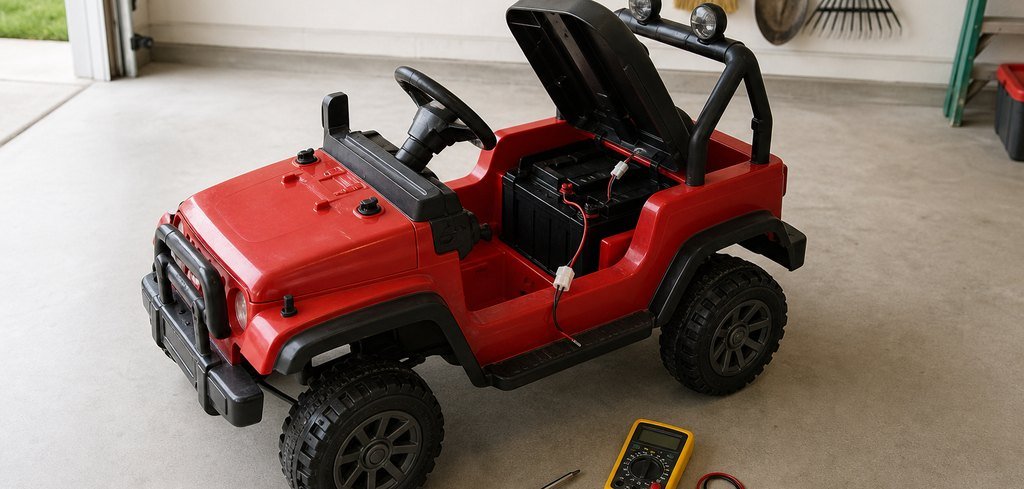
Look at the pedal first, with the battery unplugged. Mud, sand, a small toy or a bunched-up floor mat can wedge it down.
Press it and let go a few times. It should snap back up by itself, and if it doesn’t, the return spring may be broken or out of place.
2. A pedal switch that’s stuck on
Under the pedal is a small switch that carries the motor current. A stock 12V Power Wheels pulls about 10 amps running and about 20 on a hard start, and over time that can burn the contacts until they stick together.
It happens most on cars with bigger motors or a higher-voltage battery. Those push more current through a switch that was built for the stock setup.
An adult can check it with a multimeter set to continuity, battery unplugged. With the pedal up, the wire from the battery and the wire to the shifter should not connect, and if they do, the switch needs replacing.
No meter? Replacing the pedal switch is the simplest fix anyway. Order it by your car’s model number, and see my pedal repair guide for getting the old one out.
3. The parent remote is still driving it
On cars with a parent remote, the remote overrides the pedal. If a sibling has it, a button is stuck, or the car is still in remote mode, it can move with nobody on the pedal.
Switch the car to manual mode (your manual shows where that switch is), take the batteries out of the remote and try again. If that fixes it, put fresh batteries in and re-pair the remote.
4. Wiring that skips the pedal, or a failed speed controller
If it started after a mod, look there first. One wire on the wrong terminal can feed the motors with the pedal up, and an add-on speed controller can fail in the “on” position.
Undo the mod, or have whoever wired it check it against a diagram. The safety section of my mod guide covers fuses and wiring basics.
5. A short from damaged or overheated wiring
A pinched or melted wire can let current reach the motors without going through the pedal. Look for bare copper, melted insulation, or connectors that look brown or warped.
If you see any of that, or smell hot plastic, stop using the car and call the maker. Overheated wiring is a fire risk, not just a driving problem.
When to stop and call the maker
Call if the switch checks out and the car still won’t stop, if any wiring looks melted, or if the car is still under warranty. Opening up the electrics yourself can void it.
Mattel’s Power Wheels service line is 1-800-348-0751, and Peg Perego’s is 1-800-728-2108. For a brand you bought on Amazon, start with the seller’s contact in your order and ask for a replacement pedal switch or control board.
Check for recalls, especially on an older car
In 1998, the CPSC and Fisher-Price recalled about 10 million Power Wheels sold since 1984 to repair their electrical parts. The recall listed about 150 fires and 71 reports of vehicles not stopping.
If you bought an older or used ride-on, search its name on cpsc.gov/Recalls before your kid drives it. It takes a minute.
How to keep it from happening again
- Keep the pedal area clear of mud, sand and toys, and check that it springs back whenever you check the tires and battery.
- Added bigger motors or a higher-voltage battery? Upgrade the pedal switch too, or wire it to a relay so the switch only carries a small current.
- Keep the parent remote with an adult, not a sibling.
- Practice stopping before practicing speed. Mattel’s own advice to kids is to “simply remove your foot from the pedal to stop,” and here’s how that braking works.
For the other side of the problem, a car that won’t go at all, start with my ride-on not working checklist. The general safety basics are in are ride-on cars safe.
FAQ
Why does my Power Wheels keep going when my kid lets off the pedal?
Usually a pedal stuck down or a pedal switch whose contacts have stuck closed. Unplug the battery, check that the pedal springs up, then check or replace the switch.
Can a ride-on car drive by itself?
Only if something is still feeding it power: a parent remote in control, a stuck switch, or a wiring short. Switch it to manual, take the remote’s batteries out and unplug the car’s battery while you look.
Is it OK to keep using it if it only happens sometimes?
No. A switch that sticks now and then can stick again at the worst moment, so park it with the battery unplugged until it’s fixed.
Do Power Wheels have brakes?
Yes, but not a brake pedal. Lifting the foot shorts the motors, which stops the car. See how Power Wheels brake.
Unplug it, then check the pedal, the switch, the remote and the wiring, in that order. If none of those is it, or anything looks melted, the car goes back to the maker before it goes back on the lawn.