The short answer
- Most Power Wheels can climb a gentle lawn slope, slowly. Steep hills are off limits: Mattel’s manuals say generally level ground only.
- They stall because of weight, plastic wheels slipping, and the battery’s thermal fuse tripping when the motors work too hard.
- What helps, in order: less weight, better traction, then a 24V or 4-motor car. A bigger battery adds run time, not climbing power.
If your backyard has a slope, this question comes up again and again on r/PowerWheelsMods. Here’s why the car gives up halfway, what actually fixes it, and where the safe limit is.
On this page
Why Does My Power Wheels Stop on Hills?
Climbing takes far more current than driving on flat ground. The motors slow down, heat up, and pull more from the battery the harder they work.
Mattel lists hills, towing, too much weight and hitting fixed objects as the things that stall the wheels while power is still going to the motors. That’s exactly what trips the battery’s thermal fuse.
It stops, then runs again after a rest
That’s the thermal fuse doing its job. Power Wheels batteries have a self-resetting fuse, and Mattel says to take your foot off the pedal and wait about 25 seconds. Peg Perego’s breaker resets in about 10 to 30 seconds.
Never bypass it or fit a bigger fuse. If it keeps tripping on flat ground with a normal load, call the maker, and see my Power Wheels fuse guide.
The wheels spin but the car doesn’t climb
Hard plastic wheels have little grip on grass, and less on wet grass. Once a drive wheel starts spinning, it digs into soft ground and the car stops climbing.
What Actually Helps a Power Wheels Climb?
Try these in order. The first two are free or close to it.
- Lighten the load. One rider instead of two, no wagon behind, nothing in the bed. More weight means more current, more heat and less speed, and riders over the weight limit trip the fuse even on flat ground.
- Charge it fully. A half-charged battery sags under load and quits sooner on a slope. Charge with the car’s own charger for the hours in the manual, as in my charging guide.
- Add traction. Traction bands or a rubber coating on the drive wheels stop the spinning. My guide to adding traction to Power Wheels shows both.
- Pick a car built for it. A 24V car with rubber tires and two or four motors climbs far better than a 12V car with plastic wheels.
One catch with traction: grip puts more load on the gears. At stock voltage it’s fine, but traction plus a voltage upgrade on stock plastic gears is the classic way to strip them.
What Doesn’t Help
| Idea | Does it help on hills? | Why |
|---|---|---|
| Bigger battery (more Ah), same voltage | Not much | More amp-hours mean longer run time, not more pulling power. |
| Bypassing the thermal fuse | Never do it | The fuse is what keeps a stalled motor and the wiring from overheating. |
| Higher voltage on a stock car | Adult job only | It needs a fuse, a matching charger and often new gears. Read the mod guide’s safety section first. |
| Taking a run at the hill | Risky | The car comes back down faster than it went up, and Mattel warns it can roll back at an unsafe speed. |
If you do change batteries, read my replacement battery guide first, because the voltage, plug and charger all have to match.
Which Ride-Ons Handle Slopes Best?
Look for three things on the listing: 24V, rubber or rubber-tread tires, and 4WD or four motors. A two-seater with four motors still slows down on a hill with two kids aboard, so check the weight limit with both riders.
My 4×4 ride-ons with rubber tires list is built around exactly this, and the best Power Wheels for grass covers bumpy, soft yards.
How Steep Is Too Steep?
Mattel’s manuals say to ride on grass or hard surfaces and generally level ground only, away from steep inclines. Near a steep slope, Mattel warns the car can gain unsafe speed even with the pedal released, tip over, or roll backward.
That means the brake isn’t enough on a hill. Most ride-ons stop by cutting power when your kid lifts off the pedal, and gravity doesn’t care about that.
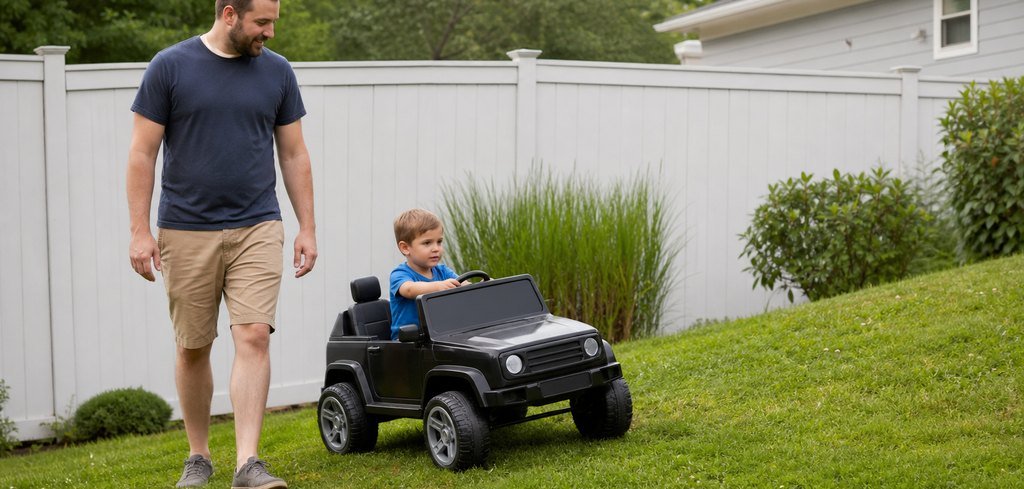
Safety first: keep ride-ons on gentle slopes only, with an adult right there. Go straight up and straight down, never across a slope, since that’s how they tip. Keep them away from driveways that run into a street, and from pools, steps and retaining walls at the bottom of a hill.
A parent remote helps on a sloped yard, because you can stop the car without waiting for your kid. My ride-on safety guide has the rest.
FAQ
Can a 12V Power Wheels go up a hill?
A gentle one, with one light rider and a full charge. On a steeper or wet slope the plastic wheels slip or the thermal fuse trips, and Mattel says to stick to generally level ground.
Will a bigger battery help my Power Wheels climb hills?
Not much. A bigger battery at the same voltage runs longer but doesn’t pull harder. Traction and a lighter load help more.
Why does my Power Wheels stop on a hill and then start again?
The battery’s thermal fuse tripped from the extra load. Take your foot off the pedal and wait about 25 seconds.
Is a 24V ride-on better for hills?
Yes, especially with rubber tires and four motors. The same slope rules still apply.
If the car stalls on your slope, lighten it, charge it and add traction before you buy anything new. If the yard is mostly slope, start with a 24V four-motor car with rubber tires, and keep the steep part off limits.


